
Circular Value Creation in White Goods via LCA & AI-driven 9Rs
Overview
CirculAIRe is an international R&D initiative addressing one of the most pressing challenges in modern industry: the inefficiency of the linear “take–make–dispose” model in the white goods sector.
Despite a market projected to reach $1.74 trillion by 2034, the industry generates massive value loss through electronic waste and inefficient recovery processes. In 2022 alone:
- 62 million tonnes of e-waste were generated
- Recycling rates lag behind growth and are projected to drop to ~20% by 2030
- Approximately $91 billion in recoverable materials is lost annually.
CirculAIRe aims to transform this system into a data-driven circular ecosystem, where products, components, and materials retain value across multiple lifecycles.
Vision
The project moves beyond compliance-driven sustainability toward a profitable and scalable circular economy.
At its core, CirculAIRe integrates:
- Digital Product Passports (DPP) as dynamic digital twins
- Lifecycle Assessment (LCA) for environmental and economic reasoning
- AI-driven decision-making for optimal lifecycle strategies
Together, these form a closed-loop system that enables:
- Repair instead of replacement
- Component reuse instead of material loss
- Intelligent routing of products across lifecycle stages
Concept
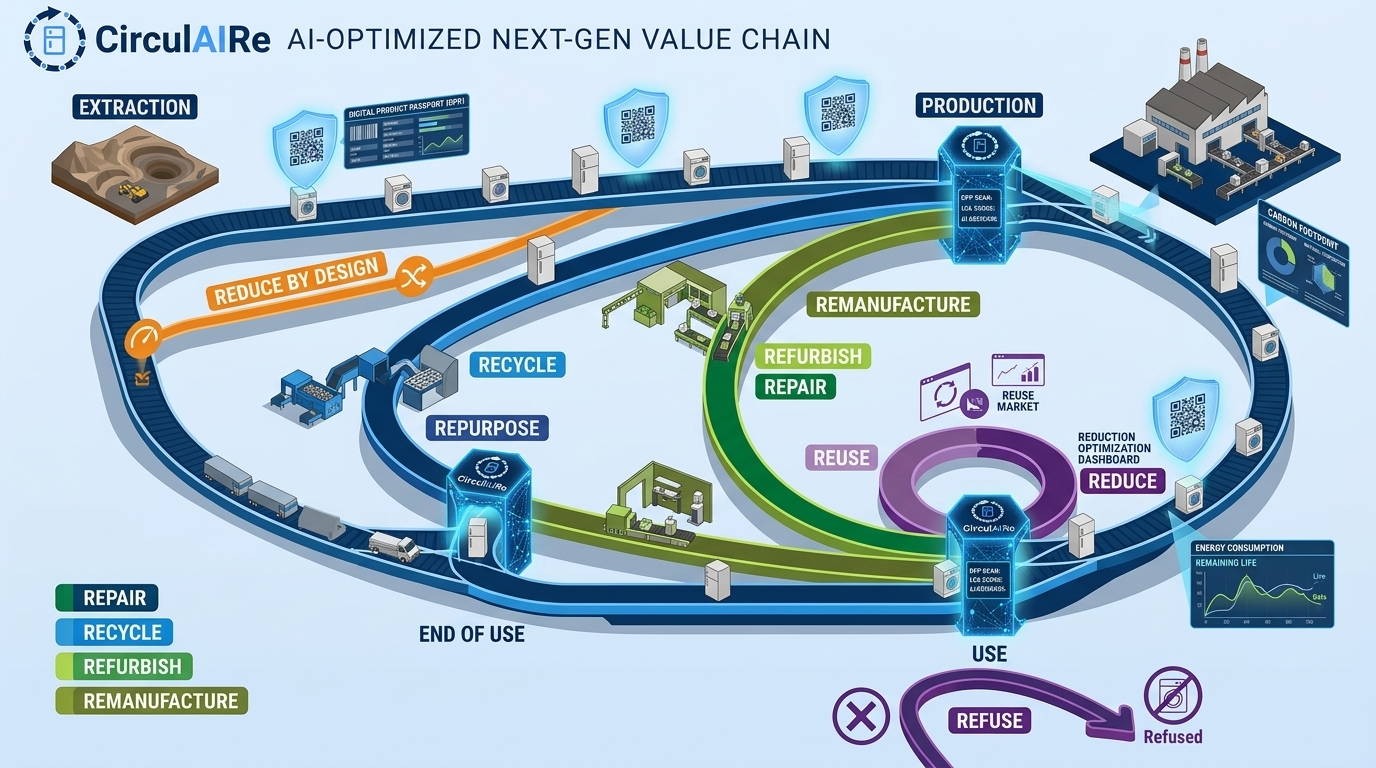
The CirculAIRe framework transforms the traditional linear value chain into an intelligent circular system.
As illustrated in the project concept (see diagram above and detailed description in the project document, page 5), the system is built on three tightly coupled layers:
1. Key Decision Points
Critical decisions across the lifecycle:
- Manufacturing → Reduce by Design
- Usage → Repair or Replace
- End-of-life → Refurbish, Remanufacture, or Recycle
2. Core Technological Stack
- Digital Product Passport (DPP) → continuous product-level data
- Lifecycle Assessment (LCA) → impact-aware decision context
- AI Decision Engine → optimization + automation
3. Circular Strategies (9Rs)
- Repair, Reuse, Refurbish, Remanufacture, Recycle
- Reduce, Repurpose, Recover, Rethink
This integration enables data-driven, optimal decisions at every stage of the product lifecycle.
My Role
My work within CirculAIRe focuses on developing the AI and computer vision systems that act as the perception and reasoning layer of the circular ecosystem.
Key areas include:
- Multimodal perception
- Visual understanding of appliances and components
- Quality assessment and defect detection
- Task & process understanding
- Modeling disassembly and repair procedures
- Learning from human experts and demonstrations
- Decision intelligence
- Supporting AI-driven routing decisions (repair vs recycle vs remanufacture)
- Integrating perception outputs with DPP + LCA data
- Human-centric AI systems
- Worker assistance and guidance
- Mistake detection and procedural support
- Robotics & automation (R&D)
- Vision-based robotic disassembly
- Policy learning for manipulation tasks
This work is closely aligned with my broader research in:
egocentric vision, multimodal learning, and AI systems for real-world industrial processes
Technical Approach
The AI pipeline follows a closed-loop learning framework:
- Multimodal Data Collection
- Vision data (cameras)
- Human knowledge (experts, workers)
- Operational product data
- Data Curation
- Cleaning, annotation, structuring
- Model Development
- Continual learning
- Multimodal fusion
- Procedural reasoning
- Vision-language integration
- Applications
- Component recognition & sorting
- AI-assisted repair guidance
- Quality inspection
- Robotic disassembly
- Feedback Loop
- Real-world performance feeds back into training
- Continuous system improvement
This creates a self-improving industrial AI system that adapts over time.
Example Use Cases
🔧 AI-powered Repair Assistance
Users scan a product QR code → AI diagnoses issues → provides step-by-step repair guidance
→ reduces unnecessary replacements and extends product life
♻️ Intelligent Reverse Logistics
Returned appliances are automatically analyzed → routed to optimal pathways:
- refurbishment
- remanufacturing
- recycling
🤖 Robotic Disassembly (R&D)
AI-driven robots identify and extract valuable components
→ enabling scalable, non-destructive disassembly
🔁 Data-driven Product Design
Failure patterns from deployed products inform next-generation design
→ improving durability and repairability
Consortium
The project brings together partners across the entire value chain:
- Fraunhofer IPK – AI, robotics, automation (project coordination)
- Vestel – OEM manufacturing and validation
- Indústria Fox – reverse logistics and remanufacturing
- TU Braunschweig – lifecycle assessment and sustainability
- yes.technology – digital platforms for reverse logistics
- Forensoft – AI and infrastructure systems
This structure enables end-to-end circular value creation, from design to reuse.
Why This Matters
The transition to circular systems is not just environmental — it is economic and strategic.
CirculAIRe demonstrates that:
- Circularity can be profitable and scalable
- AI is essential for handling real-world complexity
- Data is the key to unlocking value across lifecycles
The project provides a blueprint for:
transforming industrial systems from linear consumption to continuous value generation
Status
Approved (Planned Start: September 2026)
Updates
- April 2026 — Project approved for funding
- (Future updates will be posted here)
Contact
For collaboration, discussion, or research inquiries:
👉 https://vivekchavan.com