It was great to be back at the AI Grid Summit, held on 14–15 October 2026 at the Forum Digitale Technologien in Berlin. This was my second time attending the summit, and one of the best parts was seeing so many familiar faces again. It was also an opportunity to catch up with Germany’s AI research community, discover what people have been working on, and hear different perspectives on where the field is heading.
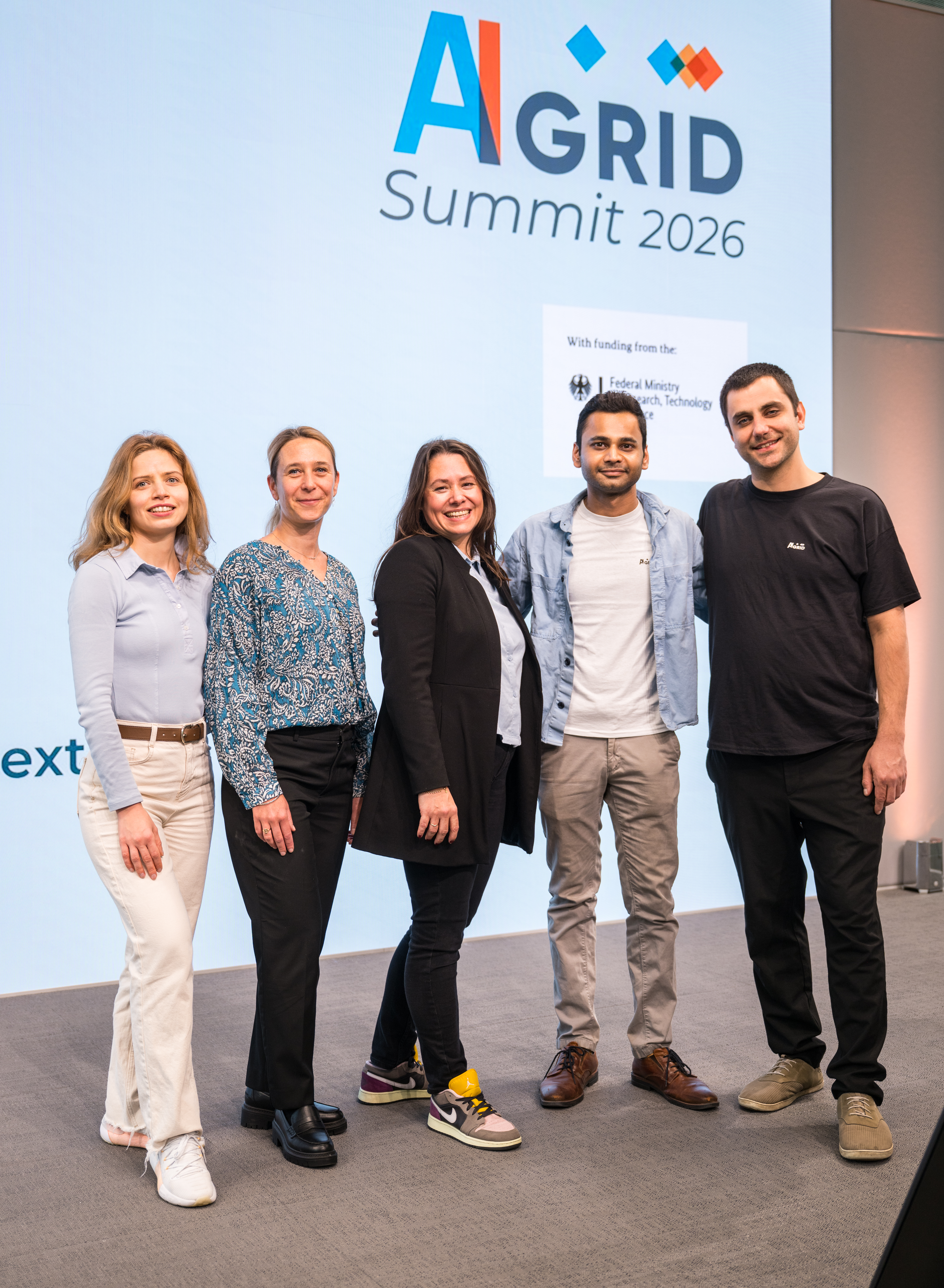
Back at AI Grid Summit 2026 with the AI Grid team.
The two days had complementary themes: connecting AI research, innovation and practical applications on the first day, and exploring career opportunities in AI on the second. That combination worked particularly well for me. As someone working on AI and robotics research with industrial applications, I am increasingly interested not only in what we can build, but also in what it takes to make research useful outside the lab.
Day 1: Connecting Research, Innovation and Application
Smaller, Smarter and More Trustworthy AI
One of my highlights was Prof. Wolfgang Wahlster’s presentation on the next generation of industrial AI systems. His central message was that advances in AI should ultimately translate into practical value for the German and European economies, not merely more impressive research demonstrations.
He discussed Germany’s AI First ambitions under its High-Tech Agenda. One target shown during the talk was for at least 50% of German manufacturing SMEs to use AI in their core processes by 2029. This is an ambitious goal. At the Mittelstandsforum I attended last year, I heard a ZEW estimate of roughly 18% AI adoption among SMEs. More recent ZEW figures put the share at just under 25% in 2025. These figures reflect different snapshots and should not be treated as a perfectly like-for-like comparison with the policy target, but they still underline the distance between current adoption and the ambition for broad industrial use.
For me, that gap is not just a question of improving model performance. It is also about cost, trust, integration into existing processes, access to expertise and whether companies can identify applications with a convincing return on investment.
Wahlster made a strong case for smaller, more efficient and controllable AI systems where they are appropriate. Compared with running the largest available models, smaller or domain-specialised models can offer lower inference costs, faster responses, reduced hardware requirements and more practical on-premises deployment. Open-weight models can also give organisations greater control over evaluation, deployment and the surrounding safety mechanisms; although openness by itself does not guarantee trustworthiness.
It was a useful reminder that the best model for an application is not necessarily the biggest model. This is particularly relevant in industrial AI, where reliability, latency, data governance and maintainability often matter as much as benchmark performance.
From Technology Transfer to Entrepreneurship
Dr. Tina Klüwer of AI Nation followed with a talk on technology transfer. A point that resonated with me was how generative AI has reduced some of the friction involved in exploring and testing an idea. Finding and synthesising information, developing an early prototype, and iterating on a concept can all happen much faster than before.
Of course, getting a prototype working is not the same as building a sustainable business. The subsequent fishbowl discussion, “From Lab to Real-World Applications,” brought together perspectives from AI Nation, TU Berlin and EURICE. The conversation touched on why researchers hesitate to pursue entrepreneurship, what it takes to turn an interesting idea into a viable offering, and the challenges of financing companies as they grow.
One recurring challenge was the European funding environment: early-stage support can help ideas get started, but scaling a company often requires a different level of capital and commercial experience. These are questions that researchers may not encounter until relatively late in the journey from lab to market.
Research Posters and an AI-for-Impact Workshop
The lunch and poster session provided a good snapshot of the breadth of AI research being pursued in Germany. I came across work spanning computational neuroscience, AI for drug discovery, climate modelling, building planning and more efficient transformer architectures. I enjoyed seeing both fundamental research and highly application-oriented projects in the same space.
In the afternoon, I participated in an applied AI workshop focused on moving from an idea toward impact. Our group had quite different backgrounds: agriculture, sustainability, and, in my case, robotics and computer vision. We combined those perspectives into a hypothetical startup concept: AI-powered agricultural robots for crop monitoring, harvesting and other forms of farm automation.
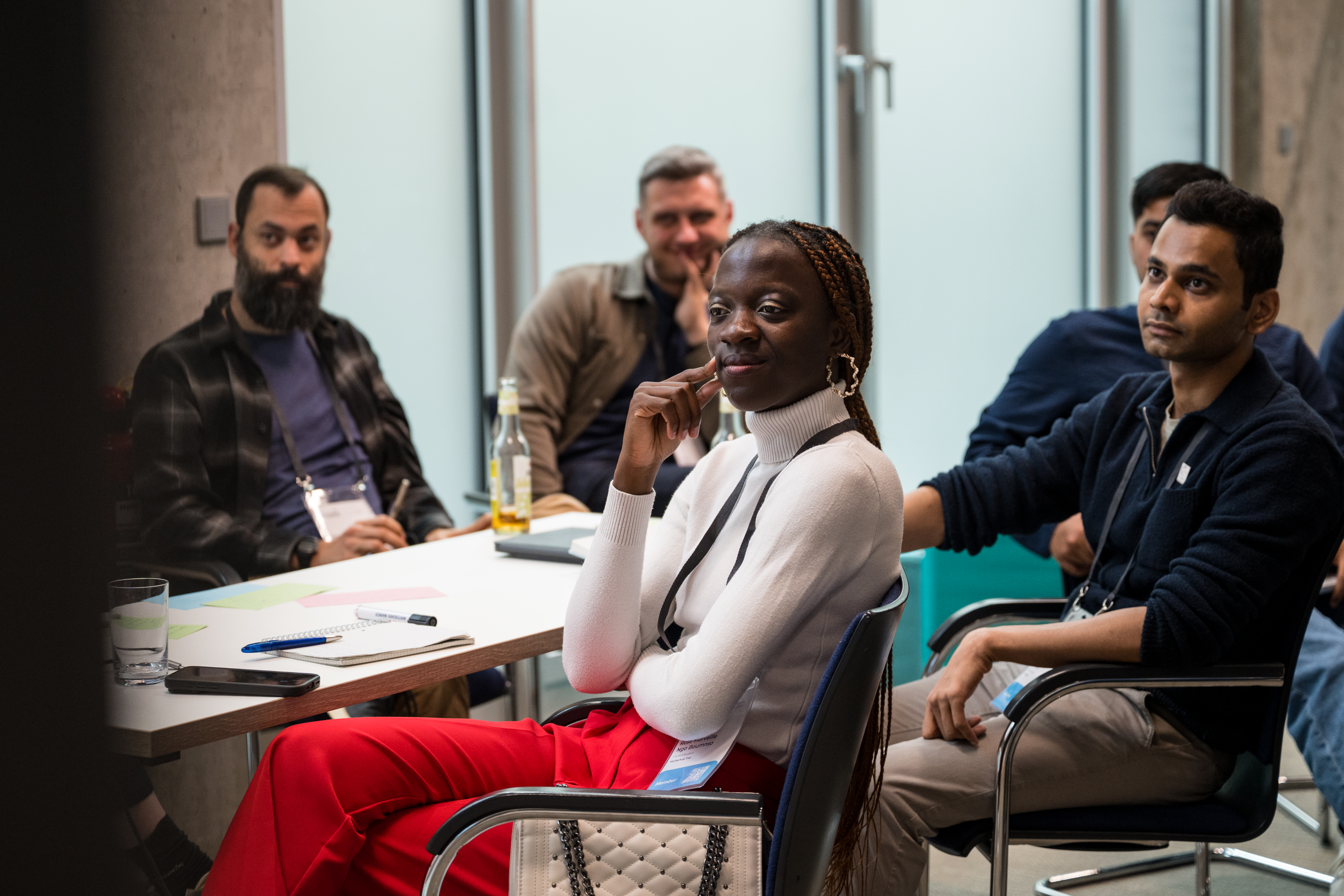
Working together during the applied AI workshop.
The interesting part was not simply coming up with the technology. We also had to ask who would actually buy it, which customer problem we should address first, and how a specialised solution could eventually reach a broader market.
This led to a discussion of “crossing the chasm”, a concept popularised by Geoffrey A. Moore. The basic idea is that persuading early enthusiasts to try a promising technology is a very different challenge from convincing mainstream customers to adopt it. The latter group usually needs a reliable solution to a well-defined problem, not just an exciting demonstration.
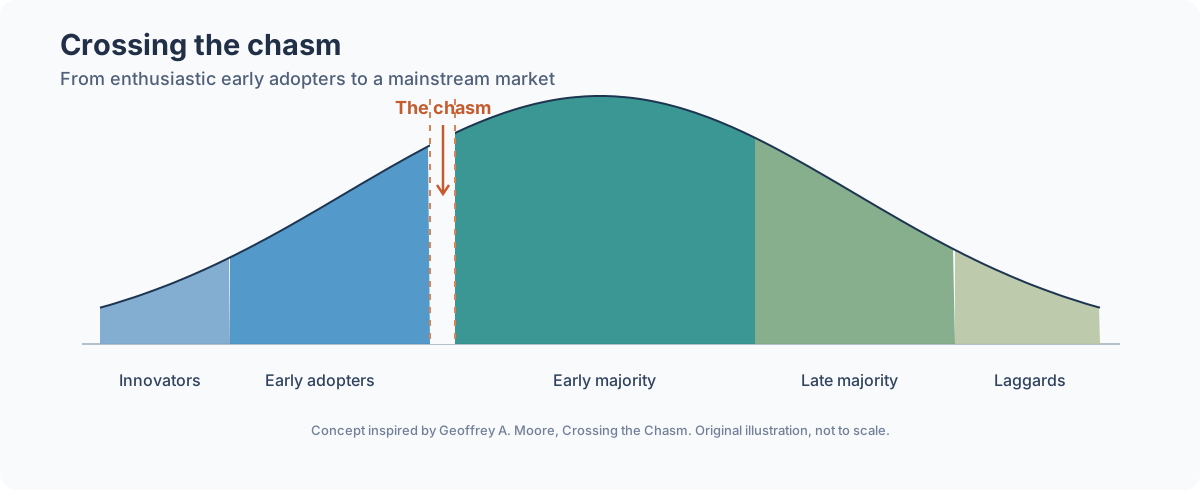
Technology adoption and the gap between early adopters and the mainstream market. Original illustration inspired by Geoffrey A. Moore's Crossing the Chasm.
That distinction feels especially important for applied AI. A working prototype demonstrates technical feasibility; sustained adoption requires an understanding of customers, costs, constraints, and deployment in the real world.
Later, I joined a science deep-dive session on small language models, led by Dr. Philippe Thomas of DFKI. We discussed practical approaches to adapting, fine-tuning and deploying smaller language and multimodal models for specialised tasks. It complemented the ideas from Wahlster’s talk earlier in the day: model efficiency is not merely an optimisation exercise, but often a prerequisite for practical deployment.
Reconnecting, Networking and PowerPoint Karaoke
The evening programme was more informal. I helped bring together participants from the AI Grid and Software Campus alumni communities over dinner. It was a smaller gathering than we had initially imagined, but that gave us more time for relaxed conversations and catching up.
Then came PowerPoint Karaoke, a format in which you are given a presentation you have never seen before and have to present it on the spot. I kicked things off with a slide deck on fairness and bias in LLM-based loan approval. This is very much outside my research area, which made the exercise even more entertaining. The objective was not to deliver a technically flawless presentation; it was to improvise and have some fun, and the audience was very much in on the joke.
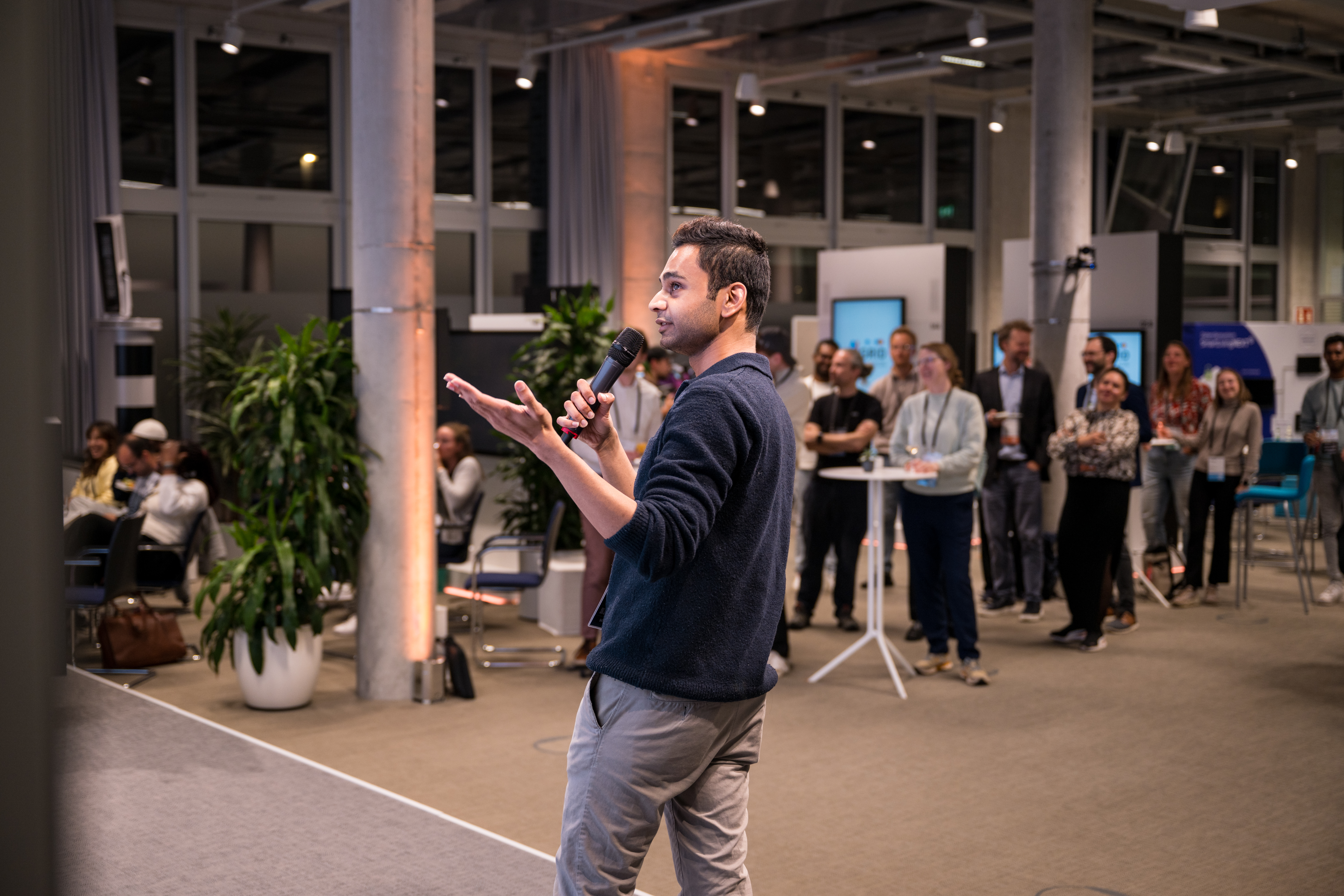
Taking the microphone during the evening's PowerPoint Karaoke.
The rest of the evening was spent talking with researchers and people from different parts of the AI ecosystem. Conversations ranged from potential research collaborations and AI regulation to experiences at other conferences and the challenges people face in their work. For me, this is where much of the value of a research community becomes tangible: conversations that do not fit neatly into any scheduled session, but can lead to an idea, a useful introduction or a new collaboration.
Day 2: Finding Your Own Path in AI
The second day was shorter and more career-oriented. Dr. Birte Seffert from the German Scholars Organization opened with a session on finding a career path that fits your own interests, strengths and priorities.
The discussion went beyond conventional ideas of career success. It encouraged us to consider where our interests and skills intersect with meaningful opportunities, and how different types of work might suit different people: research, entrepreneurship, collaboration, communication, management or building connections between others.
From Researcher to Entrepreneur
I joined the workshop “From Researcher to Entrepreneur: Developing Your Entrepreneurial Skill Set,” organised by AI Nation and Science & Startups. A valuable takeaway was that no single founder needs to possess every skill. Building a team is partly about finding people whose strengths complement one another, whether in research, product development, customer understanding or business operations.
The session also covered practical questions: how to think about a co-founder, how to evaluate whether an idea addresses a real problem, and where researchers in Germany can find advice or funding when exploring a startup. It was encouraging to see entrepreneurship presented as a set of learnable skills rather than a personality type that someone either has or does not have.
The Career & Opportunities Marketplace
After the workshops, the lunch and Career & Opportunities Marketplace brought together people representing different paths: industry, academic research, startups, public policy, and research support and exchange programmes. Instead of another panel, we could simply walk up to the different stations and ask questions.
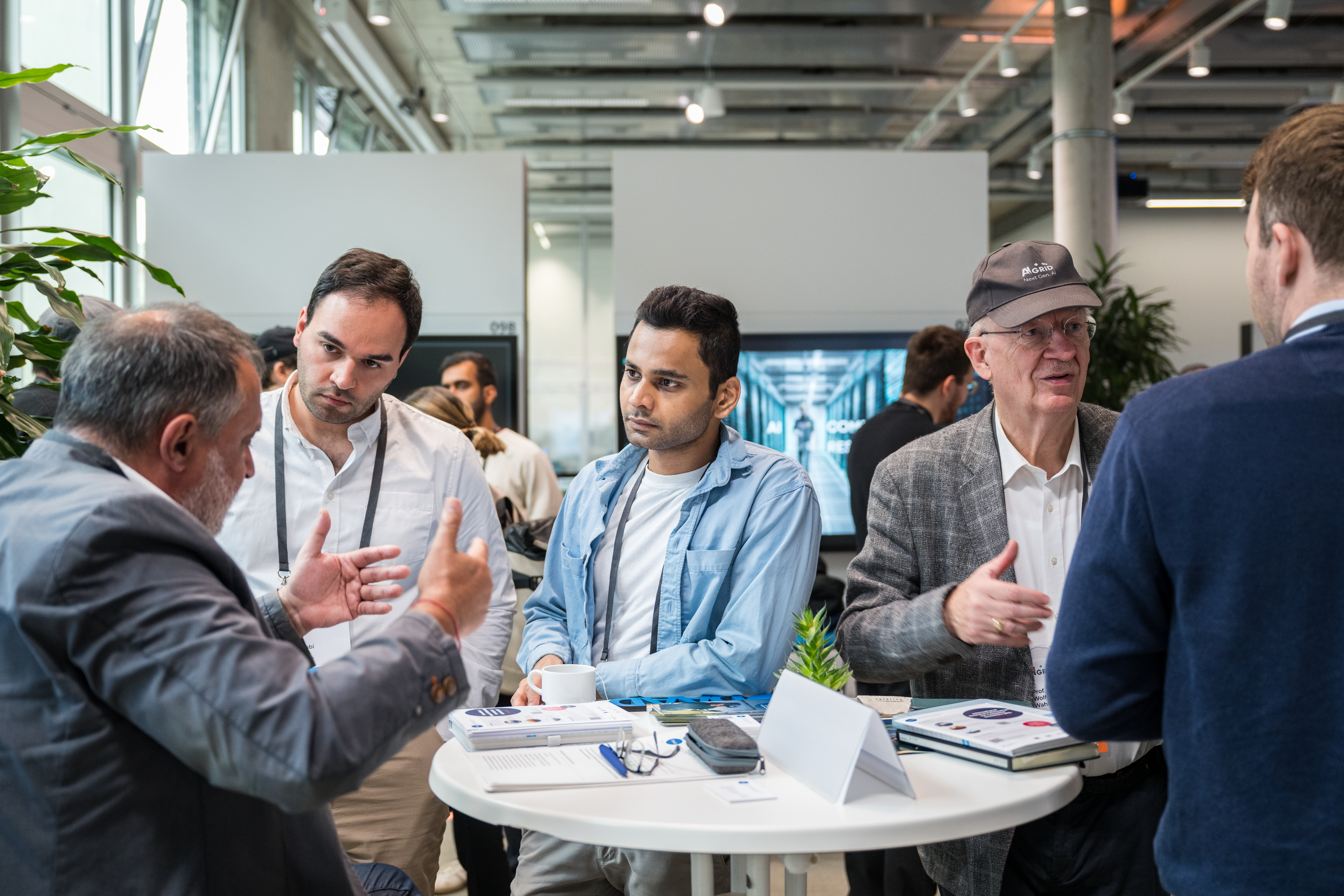
Exchanging perspectives at the Career & Opportunities Marketplace.
This was one of my favourite formats of the summit. I could listen to people from industry explain how they evaluate job candidates, hear academics describe the steps and decisions that shaped their careers, and speak with founders about the uncertainties of starting a business.
One particularly interesting conversation was with someone working in public policy, who described career decisions in terms of the life they wanted to build, not simply the largest salary or most prestigious role available. It was a useful reminder that a successful career is not a single destination, and that choosing a path also means deciding what kind of everyday life you want to have.
What I Took Away
Across both days, three themes stayed with me: research needs a credible path to adoption; researchers benefit from understanding opportunities beyond the lab; and strong communities make both of those transitions easier.
The discussions around smaller, trustworthy models, technology transfer, startups and career pathways came from different angles, but they all touched on a similar question: how do we turn technical capability into something that creates lasting value?
This was my second AI Grid Summit, and it was rewarding to see how the community continues to evolve. The most valuable moments were not necessarily the most formal ones. They were the conversations with familiar faces, the new perspectives from people following very different paths, and the possibility of staying connected beyond the event itself.
About AI Grid
AI Grid is a German network that connects emerging AI researchers with one another and with experienced mentors, researchers, and partners from academia and industry. Through events, mentoring and community activities, it helps members exchange expertise, build collaborations and explore professional opportunities. Its alumni community provides a way to stay involved and support future generations of researchers.
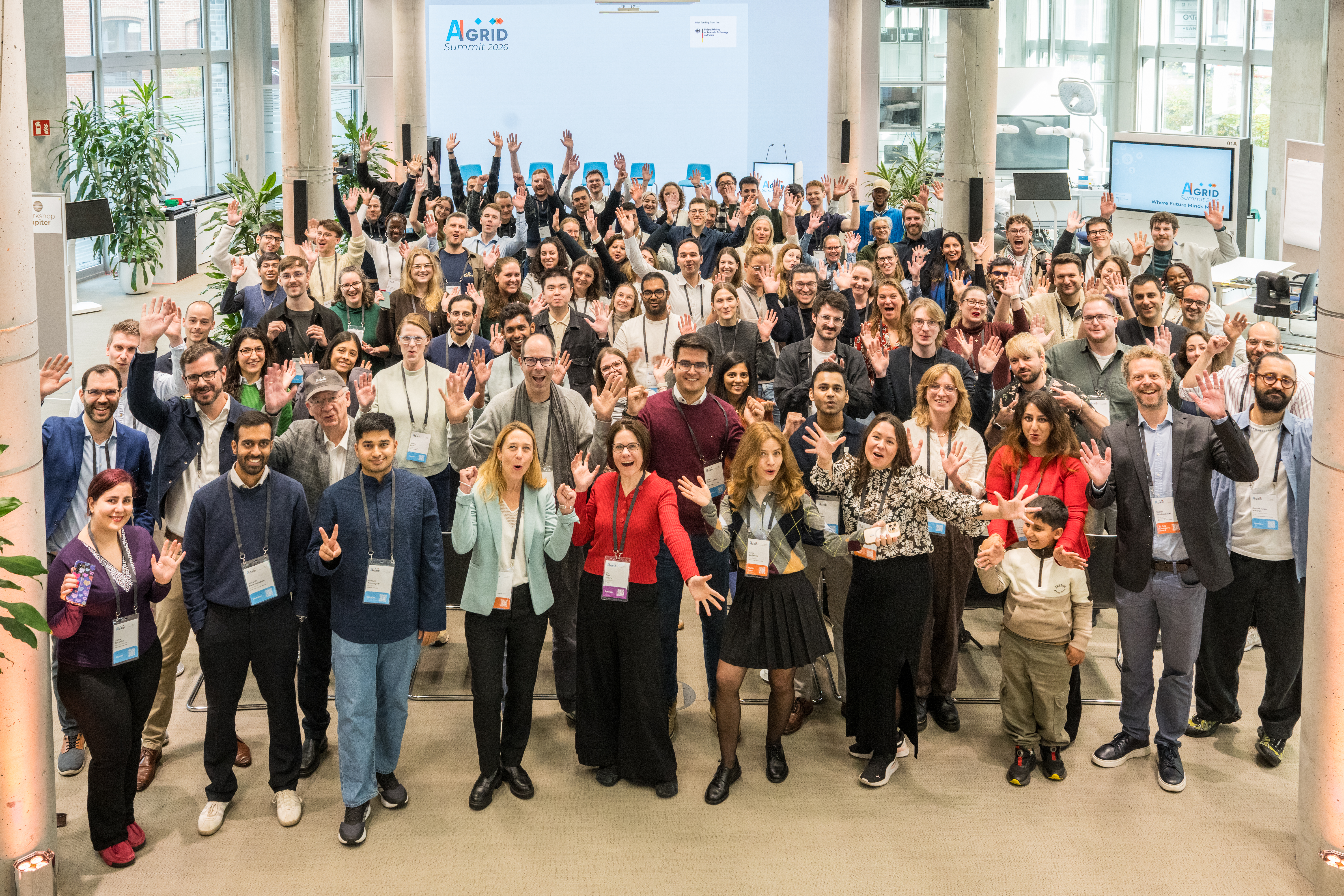
The AI Grid community at Summit 2026.
A big thank you to Laure, Varenia, Sven, Alina, and the entire AI Grid team for organising another wonderful summit! It has been great to be part of this community and see how it continues to grow, bringing together researchers, ideas, and opportunities across Germany. Looking forward to staying connected and contributing to what comes next!
Event photographs: Stefanie Loos. Original “Crossing the Chasm” illustration created for this article.
This is a personal reflection on the sessions and conversations I attended, not a comprehensive report on the entire event. Opinions are my own.
Official programme: AI Grid Summit 2026.
Discussion
Comments use GitHub through Utterances.